In Gantt view, identify which tasks drive your project’s end date, a task’s start date, or a parent task’s end date.
USM Content
Use paths in Gantt view to see which tasks affect your schedule:
- Critical path: shows the tasks that determine your project’s end date.
- Summary path: shows the subtasks that determine a parent task’s end date.
- Driving path: shows the tasks that determine the start date of a selected task.
Smartsheet updates all three paths automatically as task dates and dependencies change.
The summary and driving paths are not yet available in the new Gantt view. See Compare New Gantt view and Legacy Gantt view for more details
Before configuring any path type, you must activate dependencies.
Display the critical path in a sheet
The critical path is the longest sequence of tasks (from start to finish) that must be completed on time to stay on schedule and avoid project delays. It's determined using task start dates, end dates, duration, and dependencies (task predecessors).
As task dates or inter-task dependencies change, the sheet’s critical path can be impacted. Smartsheet automatically updates and highlights the tasks on the current critical path.
Only sheet Owners or Admins can enable dependencies to display the critical path. Anyone with Editor or higher-level permissions can edit predecessors and display or hide the critical path.
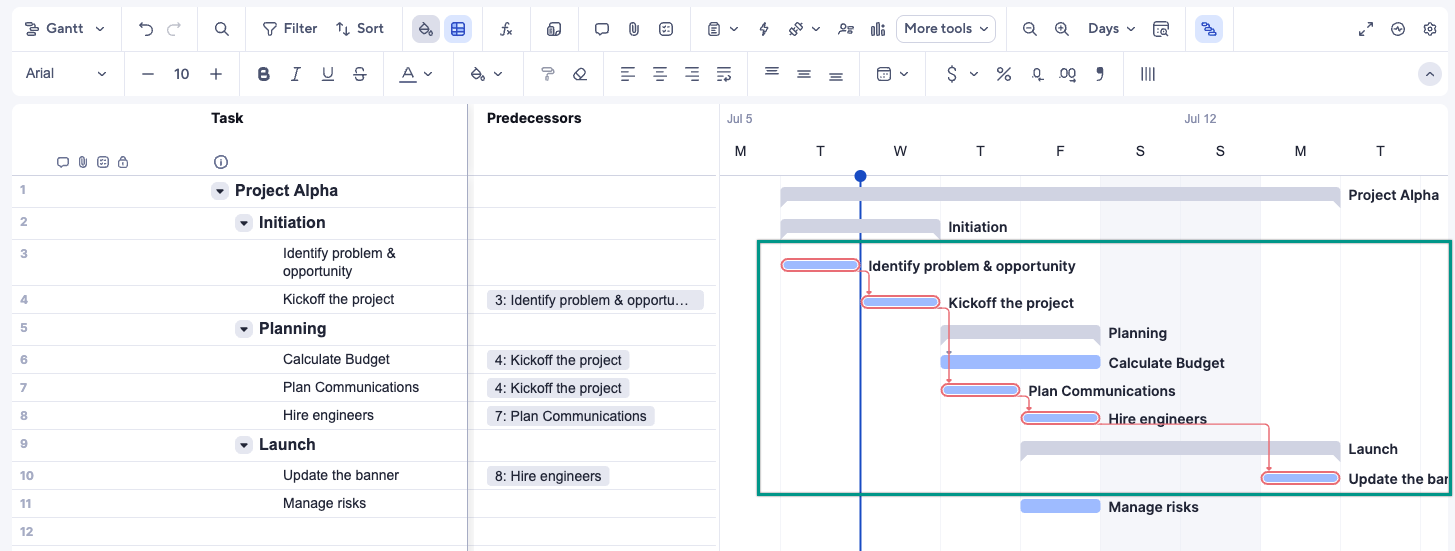
To display the critical path in Gantt view:
- Ensure dependencies are enabled. Learn more about dependencies in Gantt view.
- In your sheet, assign each task a start date, and an end date or duration.
- For each task that depends on another task, assign that other task as a predecessor in the predecessor column.
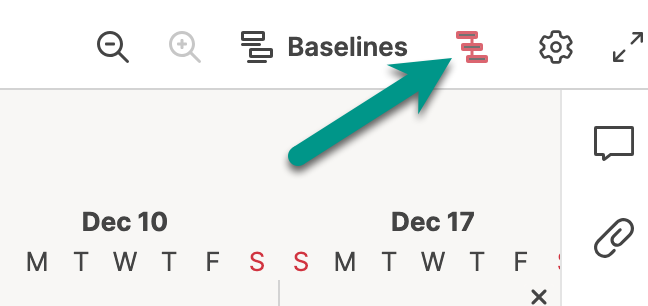
- To show your project's critical path, select the Show Critical Path icon in the upper-right corner of the sheet. The critical path and the items along it will be highlighted in red.
The critical path appears on child rows. If the rows are collapsed and you want to view the child rows, right-click the primary column and select Expand All.
If you want to show only rows on the critical path, apply a filter for that condition.
See the parent task’s critical path with the summary path
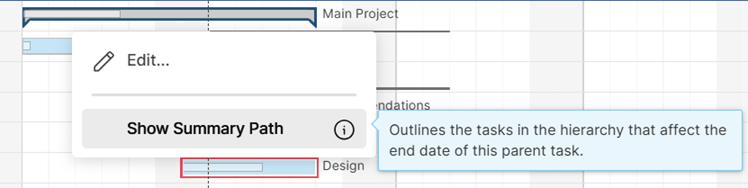
Use the summary path to identify the subtasks impacting the end date of their summary (parent) task. The summary path is a variant of the critical path. It provides a more detailed critical path for a parent task and its subtasks, rather than showing the critical path for the entire sheet. The summary path considers all child tasks within its hierarchy.
To show or hide the summary path in Gantt View:
- Right-click a parent task.
- Select Show Summary Path or Hide Summary Path.
See the driving path for specific tasks on your sheet
The driving path is based on predecessor relationships. You can enable it to identify the tasks that affect the selected task’s start date.
To show or hide the driving path in the Gantt chart:
- Right-click a subtask.
- Select Show Driving Path or Hide Driving Path.

When the driving path appears, the tasks outlined in navy blue are the ones impacting the selected row’s start date.