Format your data in Smartsheet to enhance how it looks, making it easier to interpret and analyze.
USM Content
You can format numbers and text in your sheet using the icons on the top toolbar.
Some toolbar icons may not be available for particular views or screen sizes. In some cases, you can select the More icon if you don't see the option you need.

You can also complete formatting tasks with keyboard shortcuts.
Conditional formatting
If you have Admin permissions, you can set rules to change a cell's format when the conditions you define are met.
For example, you can highlight a row in red when a deadline is past due, and a task isn’t marked as complete.
Select the Conditional Formatting icon
 and follow the instructions on your screen. For detailed instructions, refer to the conditional formatting article.
Highlight changes
Enable Highlight Changes
 to make new sheet edits stand out.
Select data to format
You can format groups of data all at once. Follow the guidance below to help with this.
| To apply formatting to | Take this action before you click a formatting icon |
|---|---|
| An entire row | Select the row number to apply row formatting to existing and newly added cells in the row. |
| An entire column | Select the column header to apply column formatting to existing and newly added cells in the column. |
| An entire sheet | Highlight all columns in the sheet. Start by selecting the header of the left-most column. Then, scroll to the right, and hold down the Shift key while clicking the header of the right-most column. When you release your click, all columns and rows in the sheet should be highlighted, allowing you to set formatting for the entire sheet. |
Indent and outdent rows
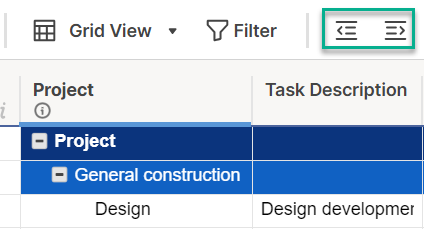
Indent rows to create an organized structure for your sheet, with child rows that fall under a parent row. For example, you can use these hierarchical relationships and formulas to automatically calculate a parent task's weighted percent complete based on data in its child tasks. Details about how to do this are included in the Parent rollup article.
The image below highlights the outdent and indent buttons in grid view and shows a hierarchy of rows.
Learn how to use hierarchy in table view in the Set up your sheet in table view article.
Format text and cells
Draw attention to certain elements of your sheet by setting various font and background formats. For example, you can set the parent rows to bold to make them stand out more.
After selecting data to format, you can set these formatting characteristics:
- font type
- font size
- background color
- alignment
- text wrapping
You can't apply borders to cells or rows.
All available fonts and cell formats are under your sheet's name in the top toolbar.

Wrap text
Select Wrap Text
 to wrap text in your selected cells and show all values within them.
Format painter
Use the Format Painter
 tool to quickly copy the formatting from one cell to other cells on your sheet.
To do so:
- Select the cells that contain your desired format.
- Select Format Painter
.
Select the desired cell to copy that formatting to.
Double-click the Format Painter icon to lock the format. You can then continuously apply the locked format to cells. Select the Format Painter icon again, or press Esc to release the locked format.
Clear formatting
Use Clear Format
 to return your selection to the default font and cell background. This is useful for quickly removing formatting without removing cell data.
Format numbers
Smartsheet's numeric display options make data clear, consistent, and easy to interpret.
Numeric formatting is for Text/Number-type cells that contain numeric, non-alphabetic characters.
The numeric formatting buttons appear grouped at the end of the top toolbar. You may need to select the More icon
 in your toolbar to see these buttons.
Here are the numeric formatting options:
- Currency Format
 formats numeric values to use the right currency symbol and decimal position.
 - Percentage Format
 formats numbers as a percentage. If you format a cell this way, the value 0.95, for example, appears as 95%. The value 95 is shown as 9,500%.
 - Thousands Format
 integrates the thousands separator and the decimal separator.
 - Increase Decimal
 and Decrease Decimal
 move the decimal point.
The symbols used for decimal and thousands separators for currency and number format are controlled by the Regional Preferences specified for your account. For more information, see the Change the Language and Date Notation article.
Format dates
Select the Date Format
 menu icon to apply standard formats to date cell values. For detailed instructions, refer to the date formatting article.
Keep in mind
- Column headers always appear in white, bold text with a grey background. You cannot change this style.
- Formatting automatically applies to a cell if it's directly above, below, or between two cells that contain the same formatting and are on the same indent level.