Move insights data from Brandfolder directly into Smartsheet.
The Brandfolder Insights data in Smartsheet integration allows users to manipulate and share this data using Smartsheet tools, like reports and dashboards.
To use this integration, users need Insights enabled on their Brandfolder and Smartsheet accounts.
Set up the integration
- Select Hi, *your name* in the top right-hand corner. Select My Profile.
- Select the Integrations tab on the left-hand side.
- Select Connect to Smartsheet within the Smartsheet Insights Data Connector Box.
- A new modal appears. Select Allow so Brandfolder can access your Smartsheet account.
- Users can select a Smartsheet Workspace from the drop-down to connect to their Brandfolder account. Select Connect.
When the connection is successful, a screen appears stating you’re successfully connected to Smartsheet
After the two platforms are connected, you will see a table that includes the Brandfolder name, the data sync status of each Brandfolder, an ellipses menu that houses the options to reset datasheets, and finally, a sync sata toggle.
If sync is toggled on, Brandfolder immediately sends Insights data to Smartsheet. From there, it updates once daily at 5:00 AM MST. If a sync fails, the user is notified in the UI.
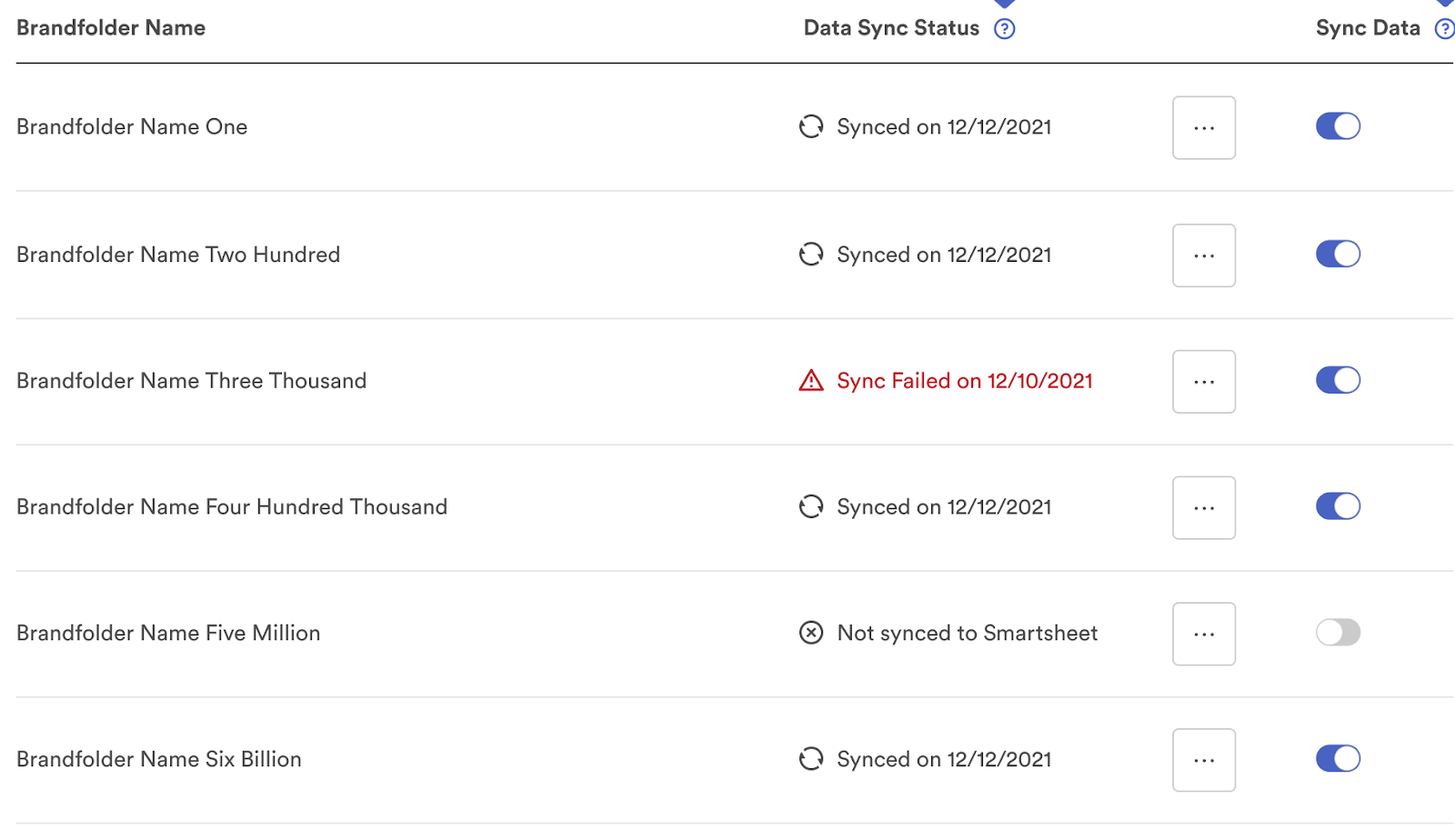
If a user cannot access specific Brandfolders in an organization, they are not listed in the integrations panel.
Navigate the integration in Smartsheet
After enabling data sync in Brandfolder, a folder named Brandfolder Integrations Folder appears in the Smartsheet Workspace you selected. This folder contains two sheets: one for the top assets of the Brandfolder and the other for the top users.
In the top assets sheet, you will see the most recent data available for the day. Columns in the top assets sheet include:
- Name
- Views
- Shares
- Downloads
- Asset link.
Select the paperclip icon in each row to open an attachment area and view a CDN and asset URL. Selecting these will open the image in Brandfolder.
The top user sheet includes the users':
- First name
- Last name
- Location
- Views
- Shares
- Downloads
Manipulate sheets
For the best experience, treat the generated sheets as read-only. Create a Smartsheet report and select the insights sheet as a source or derivative sheet so users can select which columns to display, add formatting, or add filters without modifying the source sheet.
Only owners and administrators on the sheets can edit it. If a user must edit the generated sheets, here are how manipulations of the source sheets impact the data sync:
- Default Folder: users can rename or move the default folder created by the integration.
- Sheet name and location: Users can rename or move the sheets created by the integration. If the user deletes a sheet or loses owner or admin access to it, syncing will fail.
- Columns: users can delete columns from a sheet. Deleted columns are not re-added on the next sync. Users can add formatting, sort, filter, reposition, rename, freeze, or hide columns.
- Rows: Users can delete rows from a sheet. Deleted rows are not re-added on the next sync. Users can also add formatting, sort, filter, resolution, rename, freeze, or hide rows and add additional rows to the sheet.
- Cells: during every sync, every cell in the sheet is populated with the most recent data available. Therefore, any modifications of the data in a cell is overwritten. Users may add formatting to a cell, which will be preserved between syncs. Nightly syncs do not modify cells within user-added rows or columns.
- Row or cell links: if a user generates a row or cell link, it should not be considered permanent. The top users and assets sheets include activity from the last 30 days. If an asset is not accessed within the previous 30 days or a user does not interact with a Brandfolder for 30 days, the row corresponding to the data is deleted on the next sync. On deletion, links to that data become invalid.
If any accidental changes are saved to your sheets and your data becomes unrecognizable, you can select the reset data sheets option in Brandfolder to restore the original version. To do so, simply confirm that you are trying to create a new sheet, and the original version will be restored in your Smartsheet Workspace.